

Meshy AI in 2026 presents significant advantages, notably its rapid 3D asset generation, high-quality initial outputs, and user-friendly interface, making it an invaluable tool for prototyping and accessible to non-experts. These strengths streamline workflows and accelerate content creation across diverse industries, from game development to product visualization.
However, Meshy AI also faces limitations, including occasional mesh quality issues, texture mapping inconsistencies, and mixed customer support experiences, which can necessitate manual post-processing and careful consideration of its suitability for complex production pipelines. Addressing these areas remains crucial for its continued evolution and user satisfaction.
Looking for more AI tools? Explore 500+ ranked options at top10k.com before deciding.
Understanding Meshy AI's capabilities, limitations, and cost structure is essential for anyone considering integrating AI into their 3D production pipeline. This comprehensive review will explore its features, performance, and pricing models, along with user experiences, to provide a clear picture of its market standing by 2026.
What is Meshy AI and How Does it Function?
Meshy AI is a sophisticated 3D generation tool that leverages artificial intelligence to transform text prompts and 2D images into high-quality 3D models and textures, serving as a comprehensive solution for digital content creation. It primarily functions by allowing users to input detailed text descriptions or upload reference images, which its advanced AI models then interpret to generate intricate 3D assets. This process significantly accelerates the initial stages of 3D modeling, making complex tasks more accessible to a broader range of creators.
To understand its operation more deeply, we will explore its core functionalities and typical use cases in detail. Meshy AI simplifies the creation of diverse 3D content, ranging from simple objects to complex environmental scenes, by automating many traditionally labor-intensive steps in the 3D asset pipeline.
What are Meshy AI's Core Features and Capabilities?

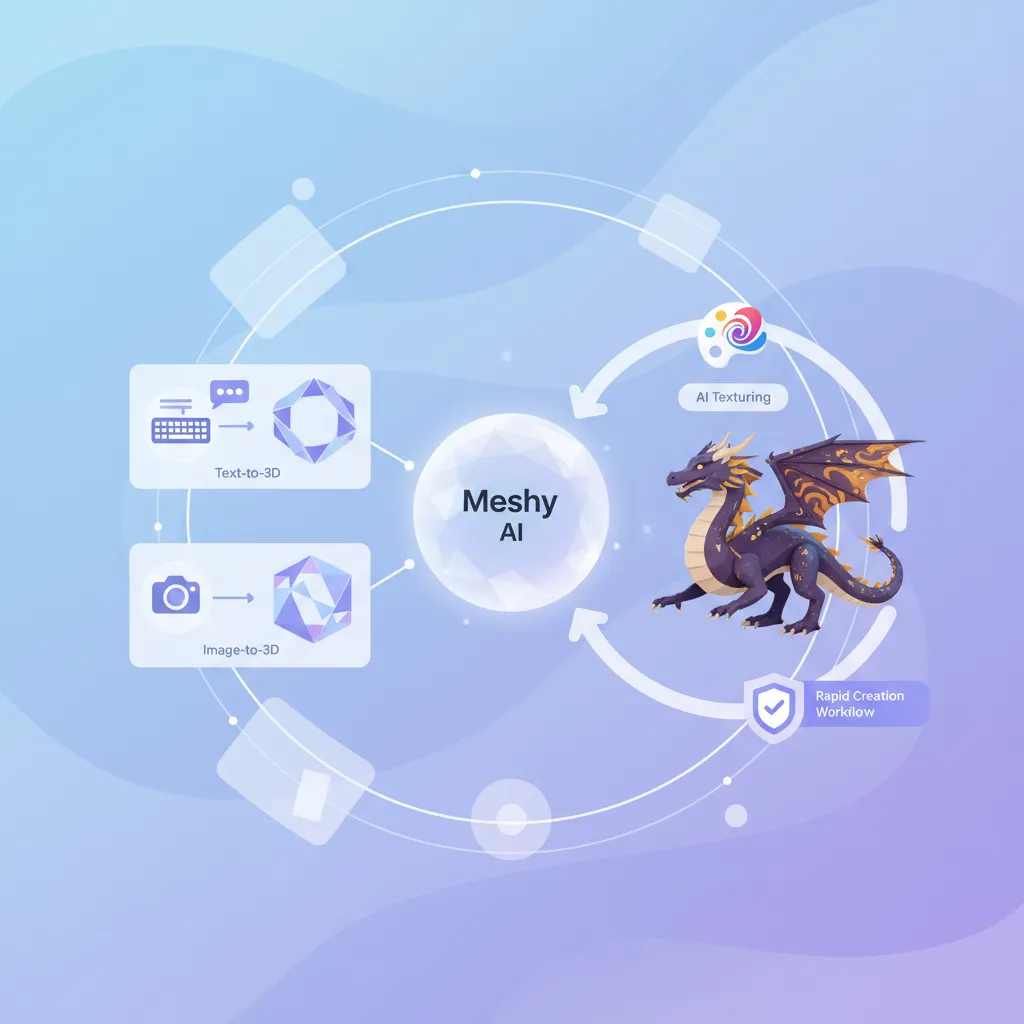
Meshy AI offers several core features, including text-to-3D, image-to-3D, and advanced AI-driven texturing, enabling users to generate and refine 3D assets efficiently and rapidly. These capabilities allow for rapid prototyping, concept development, and content creation, significantly reducing the time and effort traditionally required in manual 3D modeling processes. The platform supports various standard output formats, making it versatile for integration into different applications and workflows.
These features are specifically designed to enhance productivity and foster creativity within the 3D design ecosystem:
- Text-to-3D Generation: Users can describe their desired 3D object using natural language prompts, and Meshy AI generates a corresponding 3D model based on the input. This feature proves particularly useful for quickly conceptualizing ideas and bringing abstract concepts to life without requiring extensive traditional 3D modeling skills. For instance, describing "a rustic wooden barrel with iron bands" can yield a detailed model in minutes.
- Image-to-3D Conversion: By uploading a 2D image, Meshy AI can convert it into a foundational 3D model, providing a solid base that can then be further refined and detailed. This capability significantly accelerates the workflow for artists and designers working with existing visual references or concept art. For example, a drawing of a character can be quickly transformed into a preliminary 3D mesh.
- AI Texturing and PBR Material Generation: Meshy AI can automatically generate high-quality Physically Based Rendering (PBR) textures for 3D models, dramatically improving realism and visual fidelity. This feature is crucial for creating professional-grade assets suitable for various modern rendering engines and real-time applications, reducing the manual effort involved in texture creation. The AI can generate diffuse, normal, roughness, and metallic maps.
- Mesh Editing and Optimization: While primarily a generator, Meshy AI often includes basic tools for mesh editing and optimization, ensuring that generated models are suitable for different platforms and performance requirements. This might include polygon reduction or simple UV adjustments, although advanced editing typically requires external software.
Caption: A user interface screenshot illustrating Meshy AI's text-to-3D generation process, where a prompt is entered to create a 3D model.
What are the Primary Use Cases for Meshy AI?
Meshy AI finds its primary use cases in industries such as game development, animation, virtual reality (VR), augmented reality (AR), and product design, where rapid 3D asset creation and iteration are essential. Its ability to quickly produce diverse 3D models and textures makes it invaluable for prototyping, populating virtual environments, and enhancing visual projects with efficiency. The tool addresses the growing demand for 3D content across these dynamic sectors.
Specific applications where Meshy AI proves highly beneficial include:
- Game Development: Developers can rapidly generate environmental props, character accessories, architectural elements, or even entire landscapes, significantly speeding up game asset pipelines. This allows artists to focus on core gameplay mechanics and artistic direction rather than repetitive modeling tasks.
- Animation and Film Production: Artists can create background assets, minor characters, stylistic elements, or conceptual models much faster, allowing more focus on key animation sequences, storytelling, and intricate character work. It accelerates pre-visualization and asset creation for large-scale scenes.
- Product Visualization: Designers can quickly generate 3D models of product concepts for marketing materials, client presentations, or internal review, iterating on designs with greater agility. This facilitates faster decision-making and reduces the time-to-market for new products.
- VR/AR Content Creation: For immersive experiences, Meshy AI helps in quickly building detailed virtual worlds and interactive objects, which is critical for the fast-evolving metaverse landscape. Rapid asset creation is key for populating expansive virtual environments.
- 3D Printing: Users can generate models specifically optimized for 3D printing, enabling rapid prototyping of physical objects and custom object creation for various industrial and hobbyist applications. The AI can assist in creating manifold meshes suitable for printing.
What Are the Pros of Using Meshy AI in 2026?
The pros of using Meshy AI in 2026 largely revolve around its speed, its accessibility for non-experts, and its capability to generate high-quality initial 3D assets, making it a powerful tool for rapid prototyping and efficient content creation. Users frequently praise its efficiency in transforming simple inputs into complex 3D outputs, which significantly streamlines various workflows. These advantages collectively contribute to a more efficient and creative design process across multiple industries.
Let us delve into the specific aspects that highlight Meshy AI's strengths, examining its output quality, user experience, and overall impact on productivity.
Does Meshy AI Offer High-Quality 3D Generation?
Yes, Meshy AI generally offers high-quality 3D generation, particularly in its ability to quickly produce detailed models and textures that serve as excellent starting points for further refinement. Many users have reported satisfaction with the initial output, noting the speed and fidelity of the generated assets. The platform's advancements by 2026 have led to more consistent and production-ready results, often requiring less post-processing than earlier versions.
Key aspects contributing to its high quality generation include:
- Speed and Efficiency: Meshy AI is highly praised for its rapid generation capabilities, allowing users to create multiple iterations quickly and efficiently. This speed is a significant advantage for projects with tight deadlines, enabling concept artists to explore numerous ideas in a short timeframe.
- Detailed Textures and PBR Materials: The AI's ability to generate realistic PBR materials and textures greatly enhances the visual quality of the 3D models, making them suitable for various rendering environments. This reduces the need for extensive manual texturing, saving considerable artist time.
- Good Starting Point: While often requiring some post-processing for final production, the generated models provide a strong foundational mesh and texture set, saving artists considerable time compared to modeling from scratch. This allows artists to focus on artistic refinement and unique details rather than foundational creation.
- Variety of Outputs: Meshy AI can generate a wide range of objects and styles, demonstrating versatility that caters to diverse project needs, from stylized cartoon assets to more realistic environmental props. This adaptability makes it suitable for various artistic directions.
Caption: A rendered example of a detailed 3D model, showcasing the high-quality output achievable with Meshy AI's generation capabilities.
Is Meshy AI User-Friendly for 3D Model Creation?
Meshy AI is largely considered user-friendly for 3D model creation, especially for individuals who may not have extensive traditional 3D modeling experience, due to its intuitive interface and prompt-based approach. The platform is designed to be accessible, allowing users to generate complex assets with relatively simple text inputs or image references. This ease of use significantly lowers the barrier to entry for 3D content creation, empowering a wider audience to engage with 3D design.
Factors contributing to its user-friendliness include:
- Intuitive Interface: The platform typically features a clean and straightforward interface, making navigation and command execution easy for new users. The visual layout guides users through the generation process step-by-step, minimizing confusion.
- Prompt-Based Generation: The ability to generate models from natural language text or image prompts simplifies the creative process, allowing users to describe their vision rather than manipulate complex modeling tools. This abstraction makes 3D creation more akin to describing an idea.
- Reduced Learning Curve: Compared to traditional 3D software like Blender or Maya, Meshy AI requires a much shorter learning curve, enabling users to start producing tangible results almost immediately. This rapid onboarding is a major advantage for quick projects or new learners.
- Pre-set Options and Templates: Often, the platform provides pre-set styles, material libraries, or templates that users can leverage to kickstart their projects, further simplifying the creation process. These presets offer a starting point for various artistic directions.
What Are the Cons and Limitations of Meshy AI?
Despite its strengths, Meshy AI in 2026 still presents several cons and limitations, including occasional mesh quality issues, texture mapping inconsistencies, and sometimes frustrating customer support experiences, which can hinder a seamless workflow. Users have reported instances where the generated models require significant manual cleanup, indicating that the AI is not always perfect for production-ready assets without human intervention. These drawbacks are important considerations for potential users, particularly those with stringent quality requirements.
Comparing alternatives? Discover the full ranked list on https://top10k.com before committing to any single platform.
Let us examine the common frustrations and areas where Meshy AI could improve, particularly concerning its output fidelity and user support mechanisms.
What are the Common Frustrations and Bugs with Meshy AI?
Common frustrations and bugs with Meshy AI often include issues with mesh topology, texture stretching, occasional generation failures, and a lack of precise control over the output, requiring post-generation manual adjustments. While the AI is powerful, it does not always produce perfectly optimized or artistically precise results straight out of the box, leading to additional work for users in external 3D software.
Specific problems often cited by users include:
- Mesh Quality and Topology: Generated meshes can sometimes have irregular topology, non-manifold geometry, or excessively high polygon counts, making them difficult to animate, rig, or optimize for real-time applications. This often necessitates manual retopology.
- Texture Mapping Issues: Users occasionally encounter distorted, misaligned, or overlapping texture maps (UVs), requiring manual UV unwrapping and re-texturing in external software to achieve desired visual quality. This can be a significant time sink.
- Inconsistent Generations: While capable of high quality, the AI can sometimes produce inconsistent results for similar prompts, leading to a trial-and-error process that consumes valuable tokens or credits. Achieving a specific artistic vision can be challenging.
- Lack of Granular Control: Artists often desire more granular control over specific aspects of the model generation, such as edge flow, specific material properties, or precise form, which current AI tools typically lack. The "black box" nature of AI can be limiting for fine-tuning.
- Occasional Crashes and Bugs: Like any evolving software, users may experience occasional platform crashes or bugs during the generation process, leading to lost progress, wasted credits, or unexpected delays in their workflow.
Caption: An example of a 3D model generated by Meshy AI exhibiting common mesh topology issues, such as irregular geometry and excessive polygon count.
How Does Meshy AI's Customer Support Perform?
Meshy AI's customer support performance has received mixed reviews, with some users reporting slow response times and a lack of effective resolution for complex technical issues, while others find it adequate for basic inquiries. This inconsistency can be a source of frustration for users facing critical problems or needing urgent assistance, especially in a professional production environment. Effective and responsive customer support is vital for an AI tool that is continuously evolving and integrated into user workflows.
Areas of concern and praise regarding Meshy AI's support include:
- Response Time: Some users have noted that response times can be longer than desired, especially for non-critical issues or during peak usage periods. This can impact project timelines if urgent assistance is needed.
- Resolution Effectiveness: The effectiveness of support in resolving complex technical issues or specific generation bugs has been a point of contention, with some users feeling their problems were not fully addressed or required multiple follow-ups.
- Community Support: While official support may vary, a strong community presence (e.g., on platforms like Reddit or Discord) sometimes fills gaps, offering peer-to-peer assistance, troubleshooting tips, and workarounds. This informal support can be a valuable resource.
- Documentation and FAQs: Meshy AI provides a help center with articles covering common questions, tutorials, and known issues, which can serve as a first line of defense for users seeking solutions independently. The quality and comprehensiveness of this documentation are generally appreciated.
What is the Pricing Structure for Meshy AI in 2026?
The pricing structure for Meshy AI in 2026 is based on a tiered subscription model combined with a token system, offering various plans designed to cater to different levels of usage, from casual creators to professional studios. This approach allows users to choose a plan that best fits their specific needs, balancing desired features, generation capacity, and overall cost-effectiveness. Understanding these tiers and how tokens are consumed for different tasks is crucial for managing expenses and optimizing usage.
Let us break down the available subscription plans and determine whether a free option exists for Meshy AI, providing clarity on its economic model.
What Are the Available Meshy AI Subscription Plans?
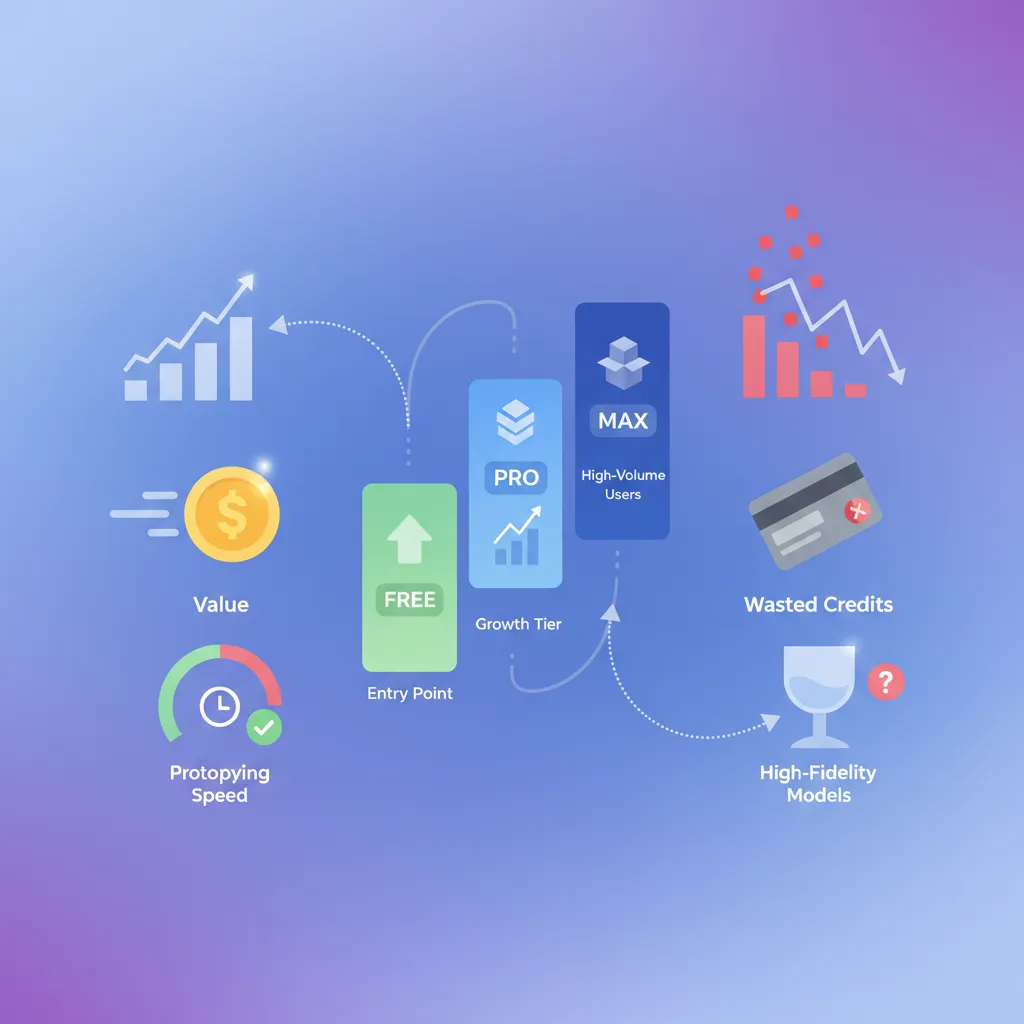
Meshy AI offers several subscription plans, typically categorized as Basic, Pro, and Enterprise, each providing a different allocation of generation credits (tokens), access to specific features, and varying levels of customer support. These plans are designed to scale with user demand, offering more resources and advanced capabilities at higher tiers to accommodate growing professional needs. The specifics of each plan, including monthly token allowances, access to advanced AI models, and higher-resolution outputs, are detailed on their official pricing page.
Here is a general overview of typical plan offerings and their intended users:
- Basic Plan: This entry-level plan is suitable for hobbyists, students, or those with lighter usage requirements, offering a limited number of monthly tokens and access to core generation features. It serves as a good starting point for exploring the platform's capabilities without a significant financial commitment.
- Pro Plan: Aimed at individual professionals, freelancers, and small teams, the Pro plan provides a significantly larger token allocation, often faster generation speeds, and typically includes access to more advanced AI models or higher-resolution outputs. This plan is designed for creators who rely on Meshy AI for regular project work.
- Enterprise Plan: Designed for larger studios, businesses, and educational institutions, the Enterprise plan offers custom token packages, dedicated premium support, API access for integration, and tailored features to seamlessly incorporate Meshy AI into existing production pipelines. This plan is highly customizable to meet specific organizational needs and scales with large-volume demands.
Each plan typically outlines the number of "credits" or "tokens" included per month, which are consumed based on the complexity and type of generation task (e.g., a text-to-3D generation might consume more tokens than a simple texturing task). Additional tokens can often be purchased if the monthly allocation is exhausted, providing flexibility for fluctuating project needs.
Caption: An illustrative table summarizing Meshy AI's subscription tiers, detailing token allocations, key features, and pricing for each plan.
Does Meshy AI Offer a Free Tier or Trial?
Yes, Meshy AI typically offers a free tier or a trial period, allowing users to experience its core functionalities with limited features and a specific number of free tokens before committing to a paid subscription. This free access is crucial for potential users to evaluate the platform's capabilities, assess the quality of its output, and determine if it meets their specific creative or professional needs without financial risk. The limitations of the free tier are generally designed to encourage progression to paid plans for more extensive or commercial use.
Key aspects of the free offering usually include:
- Limited Free Tokens: New users are often granted a small number of tokens or credits upon signing up, which can be used for a few basic generations, allowing them to test the core functionality.
- Restricted Features: The free tier might have limitations on output resolution, generation speed, access to premium AI models, or the number of concurrent tasks, guiding users towards paid options for advanced capabilities.
- Watermarks: Generated models in the free tier might include watermarks, which are typically removed upon upgrading to a paid plan, indicating the non-commercial nature of the free output.
- Non-Commercial Use: The free tier is usually intended for personal or non-commercial use, with commercial rights and full licensing reserved for paying subscribers, clarifying usage terms.
This free access serves as an excellent way for individuals to test the waters and understand the potential of Meshy AI without any financial commitment, making it accessible for exploration and learning.
How Does Meshy AI Compare to Other 3D Generation Tools?
Meshy AI distinguishes itself from other 3D generation tools primarily through its strong focus on user-friendly text-to-3D and image-to-3D capabilities, often providing a faster initial asset generation pipeline compared to more traditional or technically complex software. While traditional tools like Blender and ZBrush offer unparalleled granular control for manual modeling and sculpting, and other AI generators might specialize in specific niches, Meshy AI aims for broad accessibility and speed in concept generation. Its ease of use for creating foundational 3D assets quickly is a key differentiator in the rapidly evolving landscape of 3D content creation.
Which Industries Benefit Most from Meshy AI?
Industries that benefit most from Meshy AI are those requiring rapid prototyping, extensive asset libraries, and the ability to quickly iterate on 3D designs, such as game development, animation, and immersive media (VR/AR). These sectors thrive on efficient content creation, constant innovation, and the need to populate vast virtual environments quickly, making Meshy AI's speed and accessibility highly valuable. Its capabilities also extend significantly to product design and architectural visualization, where conceptual models are frequently needed for client presentations and design reviews.
- Game Development: For generating environmental assets, props, and initial character models, significantly reducing development time and allowing artists to focus on artistic polish and gameplay integration.
- Animation and Film: Creating background elements, secondary characters, or conceptual art for scene visualization and storyboarding, accelerating pre-production and asset creation for large-scale projects.
- Virtual and Augmented Reality (VR/AR): Populating virtual worlds and AR experiences with diverse 3D objects quickly and efficiently, which is crucial for building immersive and interactive digital environments.
- Product Design and Manufacturing: Rapidly prototyping product concepts and generating visualizations for marketing materials or client feedback, enabling faster design iterations and market entry.
- E-commerce: Creating 3D models of products for online stores, enabling immersive shopping experiences through 3D viewers and augmented reality product placements, enhancing customer engagement.
What is the Future Outlook for Meshy AI?
The future outlook for Meshy AI is promising, with anticipated advancements in model quality, greater granular control over generated assets, and enhanced integration capabilities, reflecting the rapid evolution of AI in 3D content creation. As AI technology continues to mature, Meshy AI is expected to address current limitations, such as mesh topology issues, and offer more precise artistic control, moving closer to producing production-ready assets with minimal post-processing. The industry trend suggests a strong move towards more seamless integration into existing 3D pipelines and broader accessibility for creators of all skill levels.
- Improved Model Fidelity: Future iterations are likely to produce even higher quality, more optimized meshes directly, reducing the need for extensive manual post-processing and retopology, making assets more production-ready.
- Enhanced Control: Developers will likely introduce more parameters and controls, allowing artists to guide the AI with greater precision for specific artistic outcomes, including material properties, geometric details, and stylistic variations.
- Broader Integrations: Expect more robust API integrations with popular 3D software (e.g., Blender, Unity, Unreal Engine) and game engines, streamlining workflows further and enabling direct asset import and manipulation.
- Real-time Generation: The possibility of near real-time 3D generation for interactive applications could become a reality, opening new avenues for creativity in live content creation, virtual production, and interactive experiences.
- Community-Driven Features: Feedback from platforms like top10k.com and direct user engagement will continue to shape feature development, ensuring the tool evolves in line with user needs and industry demands.
In conclusion, Meshy AI is poised to remain a significant and evolving tool in the 3D content creation landscape, continually adapting to the demands of a fast-paced digital world. Its continued development will likely make it an even more indispensable asset for creators across various industries, from independent artists to large studios.
To explore Meshy AI's capabilities further and see if it aligns with your creative or professional needs, consider visiting their official website for a detailed look at their offerings. You can also find more AI tools and reviews at top10k.com for broader comparisons and insights into the latest AI innovations.
https://capcutaffiliateprogram.pxf.io/R067oN
For a broader look at AI tools across every category, visit top10k.com to explore the full collection.
Ready to try Meshy AI?
Start with the free plan and see the results for yourself.
Get started free →